


HIP 4 is Hyperliquid’s framework for outcome trading on HyperCore. Public documentation and related explainers describe it as a native primitive for fully collateralized contracts that settle within a fixed range, with the obvious use cases being prediction markets and bounded, options like instruments. Hyperliquid’s official documentation already references “Outcome Tokens,” and its trading fees page states that outcome token trading is, at present, testnet only. A March 2026 QuickNode explainer says HIP 4 had gone live on Hyperliquid testnet by that point, expanding the platform beyond spot and perpetuals into outcome based markets.
For traders and investors with basic market knowledge, the interesting part is not the branding. It is the structure. Outcome contracts trade between 0 and 1 and settle at one of those endpoints depending on whether a defined event happens. That gives them an obvious family resemblance to binary options. Buy at 0.40, settle at 1 if the event occurs, and the gross gain is 0.60. Buy at 0.40 and settle at 0 if the event fails, and the loss is 0.40. QuickNode’s explainer describes exactly that pricing logic and notes that the market price functions as an implied probability.
That sounds simple, and in payoff terms it is. The harder question is whether HIP 4 should be read as just another binary options wrapper in DeFi. The better answer is no. The payoff shape is similar, but the market design, collateral model, onchain execution, and builder composability make it a broader financial primitive than the old retail binary options model traders may remember from offshore broker sites. That distinction matters, because one product structure can look familiar while the actual risk profile and market mechanics are very different.
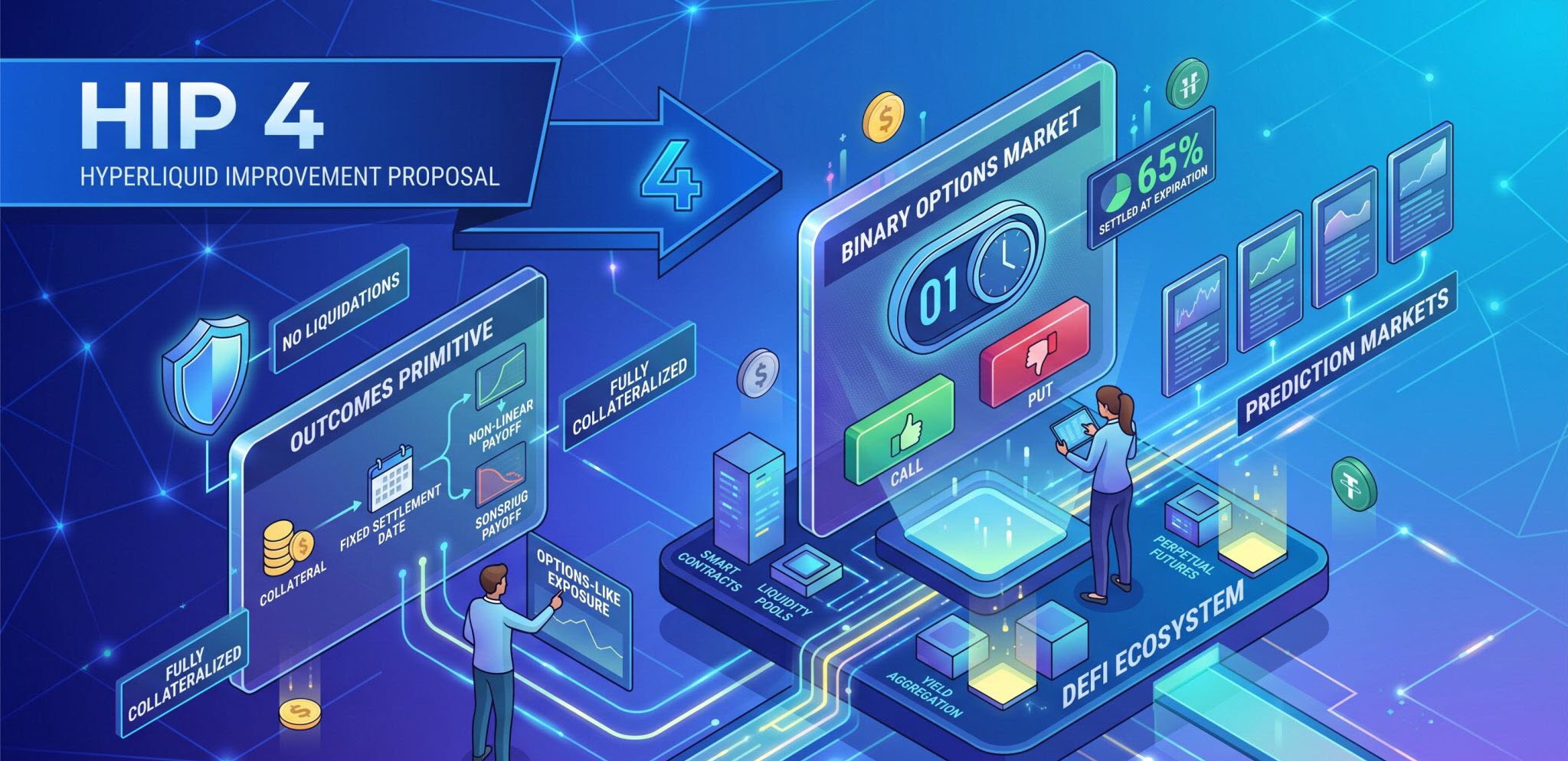
HIP 4 in context inside Hyperliquid’s product stack
To understand HIP 4 properly, it helps to place it next to the earlier Hyperliquid proposals. Hyperliquid’s documentation describes HIP 3 as permissionless builder deployed perpetuals and calls it a milestone toward decentralizing the perp listing process. HIP 3 lets deployers define markets, including oracle definitions and contract specifications, while still inheriting HyperCore’s existing order books and trading stack. QuickNode’s HIP 4 article presents the sequence more broadly: HIP 1 added native tokens, HIP 2 bootstrapped liquidity, HIP 3 opened permissionless perpetual deployment, and HIP 4 extended the surface area again by introducing outcome contracts.
That sequencing is important because HIP 4 is not being dropped into an empty venue. It is being added to an exchange design already built around onchain order books, unified trading accounts, and derivatives infrastructure. QuickNode says outcome contracts run directly inside HyperCore, using the same order book infrastructure, matching environment, and account system as existing Hyperliquid markets. In other words, these are not separate prediction widgets bolted onto the side of the platform. They are meant to sit inside the same core execution engine used for other markets.
This matters for two reasons. One is speed and consistency. Traders do not need to learn a completely separate execution model just to trade event outcomes. The other is composability. A product that is native to the venue’s core stack is easier for third party builders to integrate into analytics tools, interfaces, data pipelines, and strategy systems. That may sound abstract, though it becomes practical fast. If a market is native, it can share more of the venue’s liquidity assumptions, account design, and developer tooling. If it is bolted on, it usually behaves like a guest in its own house.
There is also a more strategic point. Hyperliquid has built its reputation primarily through perpetuals and active trading infrastructure. HIP 4 signals an attempt to widen that identity. Official and secondary descriptions frame outcome contracts as useful not only for prediction markets but also for options like financial instruments. That broadens the possible market set from crypto price exposure alone to event risk, macro releases, and bounded directional trades. For DeFi, that is a notable expansion of what counts as “tradable” onchain.
How HIP 4 outcome contracts work
Pricing, payoff, and settlement
At the product level, HIP 4 outcome contracts are straightforward. QuickNode describes them as binary instruments tied to whether a specific event occurs. They trade between 0 and 1. If the event occurs, they settle at 1. If it does not, they settle at 0. The price therefore functions as the market’s current implied probability. A contract trading at 0.65 implies the market is pricing a 65 percent chance of the relevant event occurring, though of course markets are not obliged to be correct.
The payoff for a long position follows directly from that structure. A trader who buys at price P can gain 1 minus P if the event resolves in their favor, or lose P if it does not. Since the settlement band is fixed between 0 and 1, the maximum gross loss for the buyer is the amount paid upfront. The upside is capped as well. That bounded structure is a large part of why these markets are easy to understand compared with leveraged perpetuals. You know the outer limits from the start, and there is no open ended exposure hidden in the background.
What matters in practice is that the instrument compresses a view into a probability like price. A trader is not only saying an event will happen or fail. They are saying the current price understates or overstates that probability. That subtle difference separates trading from guessing. Buying a YES contract at 0.80 because you think the event is likely is not enough. You also need to think the fair price is above 0.80, otherwise you may be directionally right and still badly paid for the risk.
Why they resemble binary options but are not the same thing in practice
It is reasonable to call HIP 4 outcome contracts binary options adjacent. The payout shape is binary. The settlement endpoints are binary. The probability style pricing is binary. If you traded classic digital options, the logic feels familiar right away. But stopping there misses the point.
The old retail binary options model, especially the offshore version that damaged the category’s reputation, usually revolved around broker quoted products with opaque pricing, fixed payout tables, embedded house edge, weak transparency, and often poor conflict management. In many cases the venue was the market maker, the counterparty, the rule setter, and the dispute handler all at once. That model gave the product a bad name for reasons that were not hard to find.
HIP 4, by contrast, is being framed as an onchain market primitive that runs inside HyperCore’s order book and account system. QuickNode says each outcome market has its own central limit order book, and official documentation already treats outcome tokens as a trading category with separate fee behavior. That does not remove risk. It does change the market structure. Traders are dealing with an exchange style order book and defined settlement logic rather than simply accepting whatever payout matrix a retail binary broker happens to advertise.
The second practical difference is collateral and liquidation. Secondary explainers around HIP 4 emphasize full collateralization and the absence of leverage driven liquidation risk. That is not the same thing as saying the product is safe. It is saying the blow up mechanics are more contained. With a leveraged perp, the position can be directionally right over a wider horizon and still get liquidated before that thesis plays out. With a fully collateralized binary style contract, the position either resolves your way or it does not, but you are not forced out by a margin waterfall on the way there in the same manner.
The third difference is composability. Outcome contracts are being pitched as a general purpose primitive for prediction markets and bounded options like structures. That is broader than the usual retail binary product, which was often just a packaged short term bet. In DeFi, the market itself can become an input for other applications, data services, and builder products. That does not make the trade better priced by magic. It does make the design space wider and more useful than the older broker centric binary model.
Margin, fees, and execution model
One of the cleaner selling points of HIP 4 is its defined risk structure. Hyperliquid’s official fees page says outcome token trading only charges fees when closing or settling, not when opening outcome positions, and labels the feature as testnet only at present. That is a notable contrast with many derivatives products, where opening and closing costs can both matter materially for short term traders.
Execution is also central to the design. QuickNode states that outcome markets run inside HyperCore and use the same onchain order book infrastructure as other Hyperliquid markets. That suggests familiar exchange style behavior for order placement and matching rather than a broker side pricing model. For traders, that means the usual execution questions still matter: spread, depth, queue position, slippage, and event driven order book stress. The product may be simple, but the market microstructure is not automatically simple just because the payoff chart is.
Compared with perps, the absence of aggressive leverage is the more important mechanical distinction. Hyperliquid’s risks page describes how liquidations work in its perp system, including maintenance margin thresholds, backstop liquidations, and the possibility that traders lose the maintenance margin buffer during backstop events. Outcome style contracts are being discussed in contrast to that model, as fully collateralized and therefore not dependent on the same liquidation machinery. This is not a trivial product tweak. It changes the trader experience from managing dynamic margin pressure to managing a fixed risk stake.
There is a catch, of course. Removing leverage and liquidation does not remove bad pricing, event uncertainty, or thin books. A trader can still overpay for probability, misread event timing, or get stuck in a shallow market. Defined loss is still loss. It just tends to arrive in a quieter tone.
DeFi use cases for traders, builders, and market makers
HIP 4 matters because it opens a new class of onchain markets. QuickNode and other explainers present outcome contracts as suitable for prediction markets, event trading, and bounded financial structures that resemble options. That means traders can express views on more than simple spot direction. They can trade around macro releases, protocol governance outcomes, policy events, product launches, listings, or any event that can be defined clearly enough for market creation and settlement.
For traders, the attraction is usually cleaner risk packaging. Instead of deciding how much leverage to apply to a perp before a volatile event, a trader can buy or sell a bounded contract that expresses the same directional or event view with known downside. That does not make the trade cheap, but it often makes it easier to size.
For builders, the attraction is that outcome contracts are native to the stack. QuickNode points out that developers can query market state, order book depth, and settlement events using infrastructure similar to what they already use for Hyperliquid. In plain terms, that lowers friction for building front ends, data products, risk dashboards, and event market tooling on top of the primitive.
For market makers, the attraction is obvious as well. Probability priced markets can be warehoused and quoted using familiar techniques, especially when the venue already supports an order book environment and a shared account system. The harder part is not quoting. It is handling event resolution, jump risk, and liquidity quality near critical information releases.
The main risks: liquidity, oracle design, infrastructure, and event resolution
The easiest mistake with HIP 4 is to see “fully collateralized” and hear “low risk.” That would be sloppy. Fully collateralized means the loss mechanics are bounded at the position level. It does not mean the market is robust, liquid, manipulation resistant, or easy to settle fairly.
Hyperliquid’s own risks page is a useful place to start. It flags smart contract risk, L1 risk, market liquidity risk, and oracle manipulation risk. The page states that Hyperliquid runs on its own L1 and notes that it has not undergone the same level of testing and scrutiny as more established chains such as Ethereum. It also warns that low liquidity can lead to significant slippage and substantial losses, and that compromised or manipulated validator maintained oracles can distort mark prices. Those warnings are generic to the venue, but they matter even more in event driven markets, where thinner liquidity and more abrupt repricing are common.
Liquidity is the first obvious issue. Outcome markets are often most active around a narrow price band and then suddenly gap toward resolution as information arrives. That can produce books that look deep until they are not. In a central limit order book, visible liquidity is only useful until participants pull or reprice. Binary style markets are especially prone to sharp repricing because there is less room for ambiguity once the relevant event begins to resolve. A contract at 0.52 can become 0.85 very quickly if the information flow changes in one direction. That is great if you are right and terrible if you confuse a clean payoff structure with a smooth market.
Oracle and settlement design are the second issue. Hyperliquid’s public risks page speaks about oracle manipulation in the context of mark prices and liquidations. For outcome contracts, the broader challenge is not only price integrity while the market is open, but also event resolution at the end. Binary markets need unambiguous settlement rules, trusted data inputs, and clearly specified timing. “Did the event happen” is easy to say and surprisingly messy to define in practice. Traders who have used prediction markets already know this. The market can be elegant while the resolution policy becomes the real instrument being traded.
Infrastructure is the third issue. Hyperliquid says outcome tokens are testnet only in the current fees documentation. That tells you where product maturity stands as of now. A trader treating a new primitive as production hardened on day one is usually volunteering to help with product discovery, though not always on favorable terms. Venue performance, validator behavior, API consistency, indexers, and settlement tooling all matter more when a market type is new.
The last issue is conceptual rather than technical. Traders often underestimate how hard pricing implied probability can be. A price between 0 and 1 looks clean. That can create false confidence. In reality, event pricing forces you to think about information asymmetry, settlement timing, conditional dependencies, and crowd behavior. A market trading at 0.70 is not saying the event is “likely.” It is offering you a contract at a specific odds level after fees, execution frictions, and resolution risk. That distinction is where a lot of bad outcome trading begins.
What HIP 4 changes for the binary options conversation in DeFi
HIP 4 matters because it separates the binary payoff concept from the old binary options industry structure. That is the main change. For years, “binary options” usually meant a product class associated with offshore brokers, hard selling, and lopsided market design. HIP 4 points toward something else: exchange native, fully collateralized, order book traded outcome contracts that can be used for prediction markets and options like applications.
That does not magically rehabilitate every binary style instrument. The same old problems can still reappear in new clothes. Thin books, bad event definitions, dubious market creation, and predatory front ends are all perfectly possible in DeFi too. Decentralization is not a disinfectant. But HIP 4 does move the discussion onto more serious ground. Instead of asking whether traders want fixed payout bets, the better question becomes whether DeFi can support transparent, well specified, bounded risk event markets on credible infrastructure.
For traders and investors with basic knowledge, that is the right frame. HIP 4 is not interesting because it revives the old binary options pitch. It is interesting because it may replace that old pitch with a better market structure. Whether that promise holds will depend less on the elegance of the payoff diagram and more on liquidity quality, builder discipline, settlement clarity, and how the product behaves once it leaves the comfort of testnet and meets actual capital.