
A lot of novice traders throughout Africa who are interested in exploring binary options want a platform that accepts deposits and withdrawals through M-Pesa, since that is a well-known, cost-effective and reliable transaction methods and many consumers in Africa already know how to use it.
In the article below, we will look at few points that are important to think about as you develop your trading plan, including which instruments to focus on and how to pick a broker that not only accepts M-Pesa but is also ideal for you in other ways. Simply signing up with the first broker you find that accepts M-Pesa is not a good route, since having a broker that is unsuitable for your trading strategy, your needs, and your preference can destroy your bottom line and turn the trading experience into a nightmare.
M-Pesa is used in multiple countries, primarily across Africa, where it’s one of the dominant mobile money services enabling people to send, receive, and store money on their phones. In Africa, M-Pesa currently operates in Kenya, Tanzania, Mozambique, the Democratic Republic of the Congo (DRC), Lesotho, Ghana, Egypt, and Ethiopia. These markets together account for tens of millions of active users who rely on M-Pesa for a wide range of financial activities, from everyday transfers and bill payments to savings and small loans.
Beyond domestic usage, M-Pesa has international money transfer links that allow people in markets where it’s available to receive funds sent from dozens of countries worldwide through partners like Western Union and other transfer networks. In summary, M-Pesa is actively used across much of Eastern and Southern Africa, with especially strong adoption in Kenya as its original and largest market. It continues to grow both within the region and in its capacity to connect users with global remittances, and many retail brokers who are serious about the African market try to accommodate M-Pesa transfers in one way or the other.
Note: In many African countries, the local financial authority will not license and supervise retail binary options brokers. Even in countries where there is no outright ban against retail binary options brokers, it can be impossible to find a retail binary options broker that is locally licensed. This adds risk for traders in several ways. Traders living in countries where other instruments are more properly supervised, and their brokers licensed, are typically better off choosing these instruments instead. Traders can for instance engage in stock trading or spot forex trading directly, or use Contracts for Difference (CFDs) to gain exposure to financial markets. To avoid jurisdictional complexity, and reduce the risk of fraud, it is usually better for retail traders in Africa to pick brokers and instruments that are locally supervised, provided that a reputable financial authority exists locally.
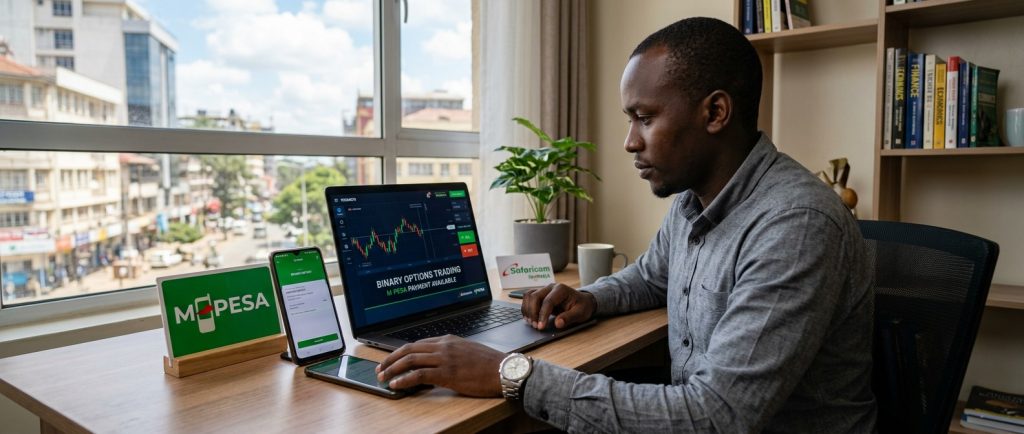
M-Pesa
M-Pesa is a mobile money service that lets people send, receive, and store money using their mobile phones, without needing a traditional bank account. It has changed how money moves for hundreds of millions of people in varius parts of Africa.
At its core, M-Pesa allows users to:
- Send and receive money instantly by phone
- Store money in a mobile wallet
- Pay bills, buy airtime, and pay merchants
- Withdraw cash from local agents
- Access savings, loans, and other financial services (in later versions)
All you need is a basic phone and a SIM card. A smartphone is not required, and neither is a bank account.
M-Pesa was launched in Kenya in 2007 by Safaricom, the country’s largest mobile network operator (partly owned by Vodafone). The name comes from “M” = mobile and “Pesa” = money (in Swahili).
The original idea was to help people repay microloans via mobile phones. But during early trials, users began utilizing the system to send money and phone minutes to family and friends, especially from cities to rural areas. Safaricom noticed this behavior and leaned into it.
M-Pesa emerged to solve some very real problems tied to limited access to banks. In the mid-2000s, most Kenyans didn’t have bank accounts. Bank branches were scarce, especially in rural areas, and fees were high. Sending money often meant physically traveling yourself, or giving cash to bus drivers or using a network of friends-of-friends. It was slow, unsafe, and unreliable. While banking access was limited, mobile phones were already very common, even in rural areas. Safaricom realized phones could act as a financial bridge. People needed a simple, low-cost way to handle normal small-scale transactions. M-Pesa essentially turned mobile network agents (small shops and kiosks) into mini-banks, letting people convert cash to digital money and back again. M-Pesa dramatically increased financial inclusion in Kenya, especially for low-income and rural populations. It is now used for salaries, rent, school fees, government services, and more, and economists have linked M-Pesa to reduced poverty levels and increased economic resilience for households. Today, M-Pesa operates in multiple countries and processes billions of dollars in transactions, but its core mission is still the same: making money transfers simple, safe, and accessible to everyone.
Points to consider before using sending a broker money through M-Pesa
When a retail broker goes through the effort of obtaining and maintaining a license from an African country where M-Pesa is widely adopted, they will typically also ensure that they can accept M-Pesa transactions. Once notable example is Kenya, where a retail trader who wants to use M-Pesa has a range of locally licensed brokers to chose among (although not binary options brokers).
Still, many retail traders go for foreign brokers instead, for various reasons. This is not without risk, because if you encounter issues with a broker operating from another country, access to recourse will very limited.
When a trader in Africa wants to use the combination of foreign broker + M-Pesa, the situation gets even more tricky, because so many of the foreign brokers available online does not offer direct merchant integration. Instead, payment agents, aggregators, and P2P flows are common. In many implementations “accepts M-Pesa” means the platform has arrangements with local payment agents or aggregators who convert M-Pesa transfers into platform credits. Those intermediaries add counterparty layers and introduce new failure modes. The agent can delay, misdirect, or disappear, and platforms can shift responsibility to the agent when disputes arise.
While direct merchant integration is uncommon for foreign platforms, it is not unheard of. Where direct integration exists, the platform is typically a formally registered merchant or an authorized payment service provider with a direct settlement account. That is a safer setup than using intermediaries, because the platform’s merchant account should show a direct payment trail. It does not remove all risks associated with foreign platforms, but the setup does reduce this specific risk element.
A trader planning on using M-Pesa needs to be extra vigilant and do their due diligence, since recovery options are pretty limited for M-Pesa transactions. Card payments (e.g. VISA or MasterCard) come with chargeback systems and bank transfers can be contested in some scenarios. M-Pesa transfers are fast and often irreversible unless the receiving party cooperates. Also, if funds are routed through an agent, the agent is the legal recipient of your transfer, and the platform is a separate party promising to credit you. Recovering funds therefore requires cooperation across two or more actors, and if they are in different jurisdictions, it becomes even more complicated. The practical consequence is straightforward: M-Pesa makes it cheap and quick to move small amounts, but it reduces your ability to forcefully reverse a payment in a dispute. That trade might be acceptable for everyday micropayments, but for speculative trading with an unlicensed counterparty based in another country, it is a material risk layer that should not be ignored, especially when it is so easy to avoid it.
Why are so many of the binary options platforms that accept M-Pesa based in offshore island nations?
As you might already now, it is difficult to find a national financial authority in continental Africa that will license retail binary options brokers. Some of them simply do not have the necessary framework, indirectly allowing retail binary options brokers to operate in a gray area. Others, such as the Kenyan CMA, have actively decided not to license retail binary options brokers, and will warn consumers about the risks associated with binary options trading. The CMA route is a part of a bigger global trend where stricter financial authorities do not license retail binary options brokers. Examples of countries outside Africa where retail binary options brokers can not be licensed, and where they are prohibited from selling binary options to retail clients even if they hold a foreign license, are Australia, the United Kingdom, and all the European Union countries.
The stricter financial authorities implemented these measures due to a combination of factors. With conventional binary options, the odds are very much stacked against the trader. The binary options industry has also become rife with fraudsters who manipulate price feeds, give out bonuses with opaque terms and conditions, and freeze accounts from withdrawals.
Many of the retail binary options platforms do not accept these prohibitions, and they want to continue to market and sell binary options to retail clients in countries where it is prohibited. Because of that, they deliberately register the company in a jurisdiction that they know has lax trader protection rules and is highly unlikely to collaborate with stricter financial jurisdictions. Many of these jurisdictions happens to be offshore paradise island nation, such as Vanuatu, the Seychelles, St. Vincent and the Grenadines (SVG), the Marshall Islands, St. Kitts & Nevis, and Comoros. This is why so many of the binary options platforms that you might come across online as you look for an M-Pesa friendly binary options broker will be based in offshore island nations.
If you run into trouble with a broker based in one of these lax jurisdictions, do not expect much help from that legal system. Also, since the broker is based are abroad, your own local legal system may not be able to do much either.
Why are the odds stacked against the trader when it comes to conventional binary options?
- The math
A binary option is a contract with a simple design. At expiry, the trader either receives a fixed payout if the stated condition is met, or lose their entire stake if it is not. It is a yes/ no and all-or-nothing design.
Simplicity is the selling point and it is appealing to many inexperienced traders. That simplicity masks the structural issues that stacks the odds against the trader.
When you get paid, you usually get paid in the 70%-90% range, depending on which binary option you bought. When you lose, you always lose 100% of your stake.
Example:
- You buy a binary option for $100. If you’re right at expiry, you get back your $100 plus an $80 profit. If you’re wrong, you lose the entire $100.
- Now assume something generous: you are correct 50% of the time. (That’s already optimistic for super-short expiries.)
- Over 100 trades: You win 50 trades and earn $80 each = $4,000. You lose 50 trades and lose $100 each = $5,000. Your net result is minus $1,000.
Even though you were right as often as you were wrong, you still lost money. That’s a key problem. With an 80% payout rate, you must be right more than 55.6% of the time just to not lose money.
That’s already extremely difficult in normal trading. In super-short binary options, where price noise dominates, it’s unrealistic.
- Retail platforms push super-short lifespans
Retail binary options platforms tend to emphasize extremely short lifespans for the options, sometimes as little as 30 seconds or one minute. Those expiries maximize trading frequency and tilt outcomes toward randomness rather than analysis. These short lifespans are often framed as an advantage. Platforms market them as opportunities to “profit quickly,” “trade the news instantly,” or “capture fast moves.” In practice, what they are really doing is introducing a time scale where meaningful forecasting becomes extremely difficult. Financial markets do not move smoothly from moment to moment. Over seconds or a few minutes, price changes are dominated by order-matching mechanics, bid–ask spread effects, latency differences, and random imbalances between buyers and sellers. These forces are largely unpredictable, especially for retail traders.
At such short horizons, even being correct about direction is not enough. A trader might correctly anticipate that a currency pair is likely to rise over the next hour, but that insight says almost nothing about where the price will be exactly 60 seconds from now. Small, random fluctuations can easily push the price slightly above or below the strike at expiry, deciding the outcome entirely. The shorter the lifespan, the more the result depends on timing luck rather than insight.
Super-short expiries create a setting where outcomes look fast and exciting but are driven mostly by randomness, while the all-or-nothing payout structure ensures that small, unavoidable price noise has outsized consequences. The result is a product that feels like making predictions about the market, but in reality operates in a time frame where genuine prediction is extremely hard and often indistinguishable from guessing.
- Super-short lifespans combined with an all-or-nothing design
Super-short lifespans combined with the all-or-nothing design of the binary option makes the situation less like conventional trading or investing and more like putting your money on red at the roulette table and hope for the best. This can trigger the same parts of your brain as gambling, and people with any tendency towards gambling addiction can fall fast if they engage with short-term binary options. The fact that we think we are trading, when we are actually gambling, makes it even more risky.
- Your broker is also your counterpart
On a binary options platform, you are not trading on an open market filled with other traders. You broker is also your counterpart. When you profit, the broker loses money, and vice versa. This introduces a built-in conflict of interest.
Having your broker as your counterpart is actually very common on conventional trading platforms as well. It is not unique for binary options platforms, and the model comes with several advantages, especially for small-scale hobby traders. Problems tend to appear when brokers are allowed to operate this model without proper supervision and accountability. Serious brokers supervised by strict financial authorities usually hedge their own exposure to manage the conflict of interest. A binary options broker operating out of a lax jurisdiction will not be held accountable, and can be tempted to manipulate the price feed, or other elements, to ensure your lose that big trade that would have made you $$$$ in profits.
Examples of broker/platform types that accept M-Pesa
When a site advertises “we accept M-Pesa” it is not a reliable proxy for safety. The label spans multiple platform types with very different legal and operational properties. For clarity, separate the platform type from the payments plumbing. Here are examples of practical categories you can encounter as you look for a broker that accepts M-Pesa.
- Locally licensed brokers that accept M-Pesa
This category consists of brokers that accept M-Pesa and are based in your own jurisdiction. In some countries, such as Kenya, you will not find any retail binary options in this category, but a lot of other instruments, e.g. for trading stocks or forex. In many jurisdictions, you use Contracts for Difference (CFDs) to speculate on a wide range of underlying assets without actually buying and selling the asset.
Locally licensed brokers will usually have a company presence in the country, with published license details, segregation rules for client funds, and formal complaint channels, although the exact details will depend on the rules stipulated and enforced by the local financial authority. Some African financial authorities have much stricter trader protection rules (and better enforcement) than others.
If you decide to go with a locally licensed broker, you should still check exactly how the broker accepts M-Pesa transactions. Is it directly, or through intermediaries?
- Foreign brokers that accept M-Pesa
This is a very broad category, and it includes everything from brokers licensed in strict jurisdiction with good trader protection rules to brokers based in extremely lax jurisdictions. Many retail traders in Africa pick a foreign broker in a strict jurisdiction because they actually have more faith in the foreign financial authority than their own local authority. And is absolutely understandable, since so many African countries have no proper framework for the licensing and supervision of online binary options brokers, and sometimes not even for other types of brokers, e.g. retail forex brokers and retail stock brokers.
With that said, you should be aware that you may not get the full protection when you are accessing the broker from a foreign country. You introduce a jurisdictional complexity that can be tricky to navigate. Also, be aware that some global brokerage brands will proudly advertise their UK FCA or Australian ASIC license, but then onboard African traders through another legal entity that operates from a jurisdiction with lower trader protection requirements.
Foreign binary options brokers
The globally available brokers that sell binary options to clients who are living in countries where retail binary options brokers are banned will typically be based in the very lax jurisdictions. Your own due diligence becomes extra important.
In practice, affiliate marketing targeting retail traders in Africa often list recommended offshore sites. That does not imply safety. The operative assumption for a trader should be higher counterparty risk and a limited recourse pathway. Some of these offshore sites have a pretty good reputation and have been in the business for a long time, while others might have popped up yesterday and will disappear as soon as they have scammed enough people. If you decide to go this route, accept that you are taking one increased operational counterparty risk and size your deposits, account balance, and trade size accordingly.
M-Pesa intermediaries
May non-African brokers that accept M-Pesa work through intermediaries. The typical flow is: You send M-Pesa to a named agent or aggregator. The agent notifies the platform. The platform credits your account. When it is time to make a withdrawal, your withdrawal request is made on the platform, and the platform instructs the agent to transfer funds to your M-Pesa wallet.
This model with an intermediary agent is common in regions where mobile money is dominant. It also concentrates several risks. Platforms can delay or apply sudden KYC or “verification” hurdles before releasing funds, and then shift blame to the agent. Or the agent can misuse funds and claim the problem lies with the platform. Recourse can be difficult, because several jurisdictions are involved. Platform/broker company registration, agent location, where your funds actually sit, and where you live and trade can all be different.
- Brokers that front third-party liquidity but retain settlement control
Some entities present themselves as exchanges or marketplaces, offering access to listed or third-party liquidity while retaining settlement control. They may promise that prices are market-based but process deposits and withdrawals through their internal systems or designated agents. Your price exposure may be traded pass-through to other counterparties, but your settlement rests on the platform. During disputes, counterparties may say “we executed against market liquidity” while the platform controls client money. The legal recourse chain is therefore complex. You may have claims against the platform and separate contractual relations with liquidity providers. Always verify which entity holds client funds and where clearing occurs.
Operational mechanics: deposits, withdrawals, agents, chargebacks
Understanding the flow of money is essential because that flow determines your realistic ability to recover funds. We have already touched on this subject above, but now we will dive into it a bit deeper.
A direct merchant integration should show a clear account identifier and an automated reconciliation path. The safest deposits are those where the platform appears as the legal recipient in the mobile money record and where the platform’s legal entity matches the merchant identifier.
Agent/P2P deposits require precise references. Common operational failure modes are mistyped references, delayed agent reconciliation, miscommunication between agent and platform, and outright fraud. Preserve screenshots, transaction IDs, timestamps and the agent’s phone number. These are the documents you will need if disputes escalate.
In many cases, everything will run smoothly until your need to make a withdrawal. Some platforms save the full KYC check until this point, or will randomly decide to throw a new and more extensive KYC check your way when you want to withdraw (especially if it is a comparatively big amount). Sometimes, this is fair, and done in accordance with applicable AML laws. In other situations, it is a deliberate stalling or freezing tactic carried out by a sketchy broker, who will never be satisfied with the documents you send in to complete your identity verification, proof of source, trading volume conditions compliance, etc. Traders can also run into withdrawal processing fees that were not clearly listed in the marketing material.
Agent flows add an extra node and potential for issues. The platform instructs the agent, and the agent executes the M-Pesa transfer. That handoff multiplies delay and places the agent’s reliability central to your exit.
If you plan to use M-Pesa for funding, run the deposit/withdrawal cycle with small amounts first and keep every record.
- Chargebacks, reversals and remedies
M-Pesa transfers do not have the same structured chargeback system as card networks (e.g. VISA and MasterCard). If the receiving party refuses to cooperate, reversal is often impossible. Without the recipient’s consent or the cooperation of the platform and agent, you might get nowhere. That is the single largest reason bigger traders tend to prefer bank rails: those rails provide stronger reversal and dispute mechanisms.
Documentation is your tool. Full logs, payment screenshots, and timestamps can matter.
Payment-only services and P2P networks used for deposits/withdrawals
P2P marketplaces and payment agents are not brokers, but play in providing M-Pesa integrations. P2P services can reduce friction and sometimes offer faster turnaround. However, they add counterparty and fraud risk (fake confirmations, delayed transfers, identity mismatch). With P2P, your exposure is to whichever counterparty fills the opposite leg of your deposit or withdrawal, and this is often another retail user or small aggregator with little regulatory oversight. If you cannot find evidence of direct merchant integrations, assume an agent/P2P model underpins the M-Pesa flows and treat it as an added risk layer.
Examples of points that need to be included in your due diligence checklist
- Does your local financial authority have a good reputation when it comes to retail trader protection? This answer may guide how you make decisions regarding locally-licensed vs. foreign trading platforms.
- Check if your local financial authority licenses and supervises retail binary options brokers. If not, check if it other locally licensed brokers and instruments are available that would be less risky for you to use.
- Do not equate “accepts M-Pesa” with “is based, regulated and supervised in an African country”. Many platforms accept M-Pesa while operating from outside Africa, and the presence of M-Pesa as a payment option does not create local regulatory protections.
- Make sure you know exactly which legal entity that will be your contract partner and where that entity is regulated. Verify any license claims directly with the applicable financial authority, because scammera and sketchy brokers sometimes lie about being licensed.
- Test the M-Pesa deposit and withdrawal process with small amounts.
- If a platform conditions withdrawals on additional spending, mysterious fees, or “VIP” upgrades, treat that as a hard stop.
- Stay away from platforms that engage in high-pressure sales tactics, including aggressive account managers who push you towards larger deposits and offer tempting bonuses with opaque terms.
- Stay away from platforms that “guarantees” profits. That guarantee is not worth anything and it is a strong red flag.
- Check the broker/platform’s reputation among other retail traders, especially traders in your part of Africa.
- Contact the customer support to see if they are knowledgeable and easy to reach.