
A binary options demo account is a simulated version of a binary trading account that gives you play-money (virtual funds) and a risk-free environment to place trades like you would on the live (real-money) platform. The point is to explore and learn the user interface, try trade entry and exit rules, validate strategy logic, and experience the workflow of the broker without risking any real cash.
Using a demo account to evaluate a broker is great, but it is also important to be aware of both the strengths and weaknesses of the demo account, and how demo accounts can vary wildly in realism and availability. Some are genuine training tools, while others are unrealistic marketing funnels created to make you believe profitable trading with this broker is safe and easy.
In this article, we will take a look at points such as how to find a demo account for binary options trading, the benefits of free and unlimited demo accounts, how to test whether a demo account behaves like the real thing, and why you should always proceed with caution as you transfer over to real-money trading.
Demo accounts are useful, but have their limitations. Use them to learn the platform and validate process, but don’t treat demo results as guarantees. Always verify broker regulation before you even start using a demo account, and be wary of any service that requires a deposit to demo, or require a lot of privat information and identity verification before you get any play-money. If you open a demo account and the broker proceeds to aggressively pressure you to fund your account and switch over to real-money trading, treat that as a red flag.
A demo account is a great way to learn how to use the platform, and a realistic demo account can also be used to verify strategy logic and test order flows. Still, we can not assume that profitability with play-money will translate into profitability with live-money, since things such as slippage and psychology will come into play in the live environment. When you decide to move to live testing, start with a micro-funded account to check execution, slippage, taxes and withdrawal mechanics in the live environment, and to gradually accustom yourself to the stress that comes with real-money trading.
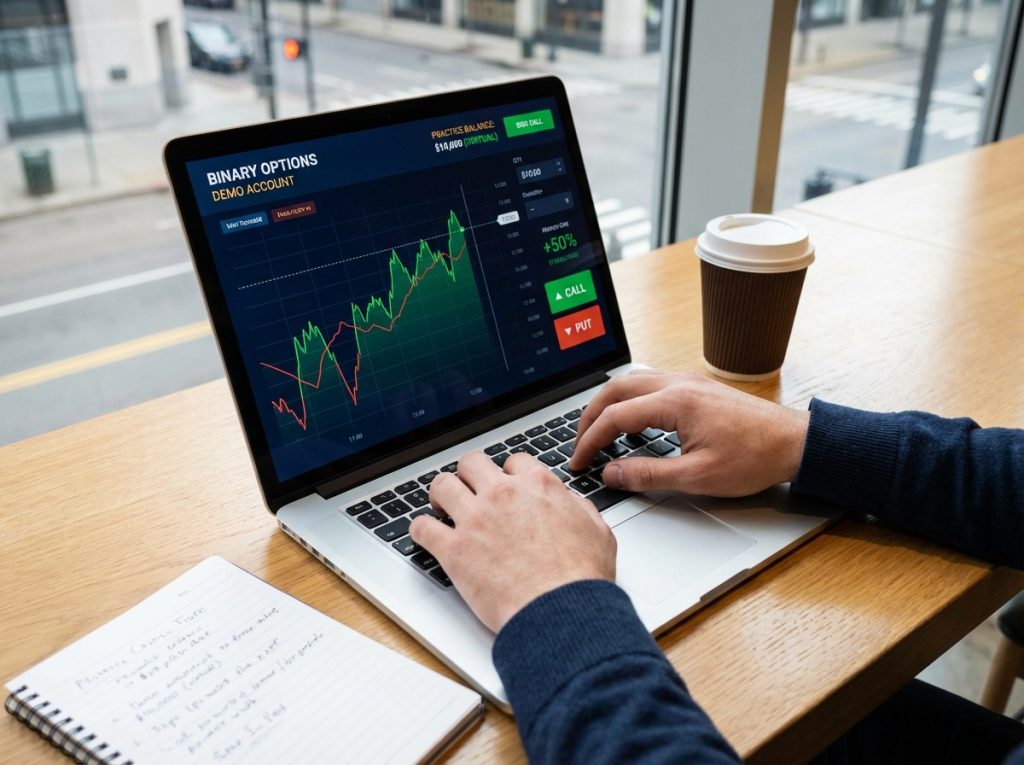
How a demo account works
Exactly how a demo account works will vary depending on the broker, but most of the reputable brokers will give you access to the same platform and features as the real-money traders, including access to the same charting and expiry screens, and the ability to use the same binary option types (call/put, touch/no-touch, one-touch, etc) and underlying assets.
Many, but not all, demo accounts mirror the live user interface and even use real-time market data so the screens feel identical. But platforms can and do tune factors such as execution, spreads, and quoting behavior in demo mode. This means that results you see in your demo account may not match a live account when the stakes are real. Use demos for procedural practice and for initial strategy validation only. Don’t treat demo account results as refutable proof your trading strategy will survive real execution and money psychology.
Do all brokers offer demo accounts?
No. Many do, but not all. Exchange-based regulated venues (for example certain U.S. regulated exchanges) and reputable brokers typically provide demo accounts. Smaller or offshore platforms may withhold a demo, or lock it behind a deposit or full sign-up. If a broker refuses to give you a demo account or requires a identity verification and/or deposit to demo without a plausible regulatory explanation, treat is as a warning sign.
Free demo accounts vs. other models
Many binary options brokers offer demo accounts, but not all of them have the same terms and conditions. Some brokers will give you a free unlimited demo, while others limit demo time, limit the free-money amount, and/or require you to open a real account and provide a lot of personal information before unlocking the demo. Some brokers even require you to make a first deposit before you can get access to the demo account.
Examples of common models are immediate free demo, demo unlocked after signing up (but only email address or phone number is required), and demo account that require a complete sign up, identity verification, and first deposit. Always check the broker’s terms before assuming demo access is unconditional.
When a broker require you to hand over a lot of personal information and verify your identity before you get access to the demo account, consider it a warning signal. The same is true for brokers that require a first deposit. One of the main points of using a demo account is to find out if you like what this broker and platform has to offer, and if it fits you general strategy, before you part with any money or sensitive information. Anti-money laundering (AML) rules and know-your-customers (KYC) rules are normally about real-money, meaning the broker is not legally required to make you jump through these hoops just to access to free play-money. A deposit requirement of full sign-up requirement is not automatically a sign of fraudulent activity, but in the binary options world, deposit requirements is a well-known tactic used by unscrupulous platforms to push traders into funding accounts. Sometimes, the line between fraudulent and high-pressure sales tactics can be blurry. If a platform demands a deposit to show you a demo, ask yourself why.
A note about minimum deposits and first deposit bonuses
As mentioned above, there are brokers who require a first deposit before you can access the demo account. This might seem like a small request; why not just make a $1 deposit and get started? Well, you are likely to run into two hurdles here.
- Some of the brokers in this category will have a high minimum deposit, e.g. $100 or more. Sometimes, it is because they know they have a shitty offering, and once you see how horrible the platform is, you will never make another deposit. They need to make sure your first deposit is big, because they know you are unlikely to give them anything else. There are also fraudsters who only pose a brokers. There is no brokerage company or trading platform, only a fraudster hoping to make a quick cash-grab. Sure, their web site might look really nice and professional, and their marketing on Telegram sounds convincing, but once you have make your first deposit, you run into a dead end and your money is gone.
- Some brokers will allow a small deposit, but work really hard to convince you to make a bigger one instead. Typically, you will be offered a big matching welcome bonus on your first deposit, or a special perk (e.g. VIP status and better account conditions) if your first deposit is above a certain level. Why deposit just $1, when you could deposit $200 and get a $200 match bonus, right? For many traders, sticking to a $1 first deposit suddenly feels wrong when a big match bonus is being dangled right in front of their nose. After all, the first deposit bonus is only available on the FIRST deposit, and if your first deposit is $1 instead of $200, you will “lose out” on $199 in bonus money. This is how many traders get lured into making a big first deposit even though they have not even been able to try out the trading platform in demo mode yet.
Bonus money typically comes with heavy strings attached. Check the terms and conditions before you agree to any bonus or other perk. Many binary options platforms will give you a bonus that freezes your account from withdrawals until you have fulfilled a very large trading requirement. This means the entire account will be frozen, not just the bonus money. Your deposits and any profits from trading are locked in together with the bonus money until your fulfill the requirement. So, if you realize in demo mode that this broker is unsuitable for you, you can not simply withdraw your money and leave.
Examples of common demo account business models
- The honest model The demo is a neutral training tool that mirrors live execution. This model is common among reputable and well-regulated brokers. They know they have something valuable to offer, and they want to make it really easy for you to find out how great their platform and general offering is.
- Better-than-the-real-thing demo model The demo is used to push users into funding accounts quickly, even if it means tweaking some of the execution parameters to make you believe your strategy will be profitable. There is still a real broker and platform available behind the scenes, but your live-money trading will probably not be as successful as your demo account experience. Some brokers in this category will tune demo fills or smooth execution to make strategies look better.
- Outright fraud The demo is a lure, and the fraudster wants to grab onto your deposit and/or use your personal information for identity fraud. Once you have deposited, it will be very difficult or impossible to ever withdraw any money.
Are demo accounts unlimited?
It depends. Some brokers provide unlimited demo use so you can practice indefinitely. Others impose time limits (30 days is common) or only give you a certain amount to practice with, e.g. $10,000 in play-money. With some, the limitations are firm. With others, you simply contact the customer service and ask for an extension or a play-money refill, and they will give you what you need, free of charge.
Note: Some brokers limit the size of individual trades in demo mode to encourage live funding.
If “unlimited demo” is important to you, read the terms and try to find independent user reports. One of the benefits of having an unlimited demo account is that you can return to it later, e.g. to learn a new feature on the platform or develop a new strategy.
Warning
If a broker unusually stingy with their demo account compared to the average broker, treat that as a warning signal. Some brokers want to pressure you into making quick decisions, and many for instance limit demo account use to just a few hours. If you want to proceed after that, you must make a deposit.
For many of us, a few hours is not enough to properly evaluate a trading platform, and it is also not very pleasant to deal with a broker that introduces this absolutely pointless source of stress. Binary options trading can be stressful enough as it is, you do not need a broker who is putting unnecessary hurdles in your way. If other brokers can give you 30 days of free demo mode and $10,000 in play-money, why can this particular binary options broker only give you 4 hours and $1,000?
Why free is not the same as risk-free
The binary options industry have a well-documented history of fraud and consumer harm, and these problems are very much an issue today as well. Many of the stricter jurisdictions (e.g. Australia, Canada, UK, and the European Union members) have banned brokers from selling retail binary options, and most retail binary options platforms are today based in offshore jurisdictions known for having very lax rules when it comes to broker conduct and trader protection.
It is easy to think that as long as you don´t make a big deposit, opening a demo account is completely risk free. This is why many traders happily sign up for a demo account without researching the broker first. They want to get a feel for the platform before they dig any deeper, and this is understandable, but it is not a risk-free approach.
- If the broker requires you to do a full sign-up and verify your identity to gain access to the demo account, you are handing over very personal information that can be used for identity theft. Remember, everything you use to verify your identity can be used by a fraudsters who want to pose as you, e.g. while defrauding others. Do not hand over your full name, address, copy of ID, copy of utility bill, etc to anyone without researching them first. Only well-regulated and reputable companies should have this information.
- Even a small deposit creates a financial link between you and the receiver, and it can trip internal security wires within your bank or other financial service providers. You do not want your bank account or payment solution account to suddenly get flagged for suspicious activity because you sent (or tried to send) money to a black listed entity or sanctioned jurisdiction.
Before you interact with a binary options platform in any way, confirm the company´s regulatory registration in the jurisdiction it claims, and verify that the regulator’s public register actually lists the firm. Also check their reputation online. If a company is in a lax jurisdiction, offers opaque payout rules, have a history of withdrawal issues, or aggressively pushes deposits and bonuses, consider it high risk.
What demos do not tell you — the key limitations
Demo accounts can be great for many things, but not confuse a demo’s surface realism with real trading conditions. Examples of important differences that can invalidate demo results include:
- Execution and slippage. Live orders may execute slower, with different fills or partial fills during live trading (real-money trading). Demo platforms often give ideal fills.
- Liquidity and order book behavior. Short expiry binary pricing depends on underlying liquidity, and demo quotes may be smoothed or synthetic.
- Emotional pressure. Risking real money changes trader behavior, and you are more likely to make decisions based on in-the-moment emotions such as greed or fear.
- Fees, spreads and payout adjustments. Some demos use different spread or payout formulas to make trading look more profitable than it will be live.
- Withdrawal and payout friction. A demo can’t teach you about things such as KYC delays, withdrawal holds, or account disputes, and these things matter a lot to the overall trading experience.
Because of these differences, do not assume your real-money results will be identical to your demo account results. If a demo shows a robust statistical edge, the next step is small-scale, funded testing under real conditions.
Psychology
A demo helps you practice position sizing rules and execution discipline. It won’t reproduce real-money stress, tax consequences, or the impulse to chase losses that appears with real capital. Use micro-funded live testing for psychological validation. One real money is on the line, we are much more likely to deviate from our planned strategy, and suddenly make decisions in the heat of the moment, spurred by emotions such as fear of loss, greed, over-confidence, or just “a gut feeling”. A lot of inexperienced traders wipe out their account balance because of revenge trading, where an especially hurtful loss propel them to “take revenge” and accept increasingly risky trades in an effort to win back the lost money.
While we are talking about psychology, I also want to caution you about using your demo account in a reckless manner. Yes, it is fun to go wild and make all sorts of crazy trades when we are only risking play-money. However, this can backfire in several ways. For starters, you might fall into a lucky streak, and believe that the outsizes profits your are seeing is the norm for a trader doing this type of high-risk trades. Also, with play money, we tend to remember the risky trades that yielded a profit, and forget about all those losses that would have hurt immensely if it had been our own hard-earned cash on the table. This can propel us into thinking high-risk trading is a good and viable strategy. Last but not least, your are forming trading habits even in the demo account, either you want it or not. That is why I recommend using the demo account in accordance with your actual trading strategy, and with the correct trade sizes. In a stressful situation, we are likely to revert back to what feels familiar, so programming your backbone with a bunch of reckless trading habits is not a good idea.
Using the broker’s mobile app for demo trading
Most modern brokers provide mobile apps for iOS and Android devices, and if you plan on doing any analysis or trading on your mobile device, it is a very good idea to check it out in demo mode first. Use the demo to find out more about features such as order flows, push notification latency, chart responsiveness, and any app-specific quirks. When you test an app demo, check that the app’s market data timestamps, execution confirmations, and account balance displays match what the web platform shows. Discrepancies between app and web are a useful early warning that the firm’s tech stack is inconsistent. If the app requires ID verification and/or a deposit before demo unlock, treat that as warning.
Using demo mode to test strategies — a practical approach
Treat the demo as step one of a staged testing plan.
- Learn the platform, set templates or alerts, and verify order entry and position display.
- Backtest logic where possible. If the platform provides historical tick or bar data, run your rules over history to confirm edge.
- Run forward demo testing for a statistically meaningful sample. It is important to run the strategy for a meaningful sample: hundreds of trades if the strategy is high-frequency, dozens if it targets longer expiries, and so on. Record every trade, reason, and outcome.
The next step will be a small deposit and venturing into live-trading using very small trade sizes. Place identical trades as in the demo account with a tiny funded account to compare execution, fills, and slippage. If live results diverge materially, dig into execution logs and contact support.
If you decide to proceed, scale carefully, and only after live tests prove the edge and you’ve built robust risk controls that handle real-world conditions well. Your should also make sure withdrawals work correctly before you make any significant deposit.
Keep a disciplined trading journal through all stages.
Evaluating whether a broker’s demo account is “good”
A good demo mimics the live environment closely. Here are a few examples of things to look for when you evaluate a demo environment.
- Same UI and instrument set as live.
- Real-time prices and identical expiry mechanics.
- Same order confirmations, timestamps, and trade history format.
- Matching spreads/payouts or transparent explanation of any differences.
- No forced behavior. Balance resets should be documented, not hidden.
- Clear terms explaining things such as whether demo mode is limited.
A reliable demo will match the live UI and instrument set well, show real-time pricing and identical expiry mechanics, use the same payout or clearly disclose differences, preserve timestamps and trade history format, and have transparent demo limits. If possible verify with micro-funded live tests to confirm execution parity. If the demo fails several items above, treat it as unreliable for anything beyond procedure practice.
Examples of binary option broker warning flags
- Demo account only after deposit and/or identity verification.
- Demo account very limited, e.g. short time or very little play-money.
- Many important platform features are blocked in demo mode.
- A pattern of withdrawal complaints from other traders.
- No verifiable corporate address.
- Opaque or contradictory regulatory claims.
- Aggressive and high-pressure marketing after you sign up for a demo.
- Promises of guaranteed returns or access to “secret signals” if you deposit.
FAQ — Binary options demo account
Are demo accounts free?
Many brokers offer free demos, but some don´t. Some brokers require a full registration and identity verification, and a subset will only unlock demo access after you deposit. Treat a demo account that requires excessive registration or an upfront deposit as a warning sign.
Is a demo account useful for beginners?
Yes, a good demo account can be great for learning terminology, the platform flow, order types, and timing. But beginners must remember the demo will not teach real emotional discipline.
Do all brokers offer free demo accounts?
No. Many reputable and well-regulated brokers do, but some smaller or offshore operators do not, or they gate demos behind deposit and/or ID verification. If a broker refuses to show a demo, treat is as a warning sign.
Do demo accounts behave exactly like live trading?
Not necessarily. Key differences can include execution speed and slippage, payout and spread formulas, synthetic or smoothed quoting. Demos may give idealized fills or slightly friendlier pricing. Use demo results for procedural checks and strategy logic, and validate with small live bets afterward. Remember that play-money trading does not equal real-money trading from a psychological standpoint.
What should I test on a demo account?
Examples of important things to test are order entry/confirmation, expiry timing, payout calculations, charting and indicator behavior, app vs web parity, and how the platform displays trade history. Also run a forward sample of your strategy to see basic behavior over real-time ticks.
Can I reliably backtest strategies on a demo?
Only if the platform provides accurate historical tick or bar data and the demo matches live quoting. Many demos don’t expose full tick history or apply different fills, so use demo forward testing, and separate backtesting tools for historical verification.
How long should I test a strategy in demo before going live?
There’s no universal number. For strategies with many small edges you want hundreds of trades. For longer-expiry setups dozens may suffice. More important than an exact count is that the sample covers different market conditions and that live micro-testing follows.
Should I use the broker’s mobile app demo too?
Yes, if plan on using the mobile app at all. Mobile execution, UI quirks, push notification timing and app-specific latency matter. Test both web and app demos and confirm they show identical prices, timestamps, and history for the same trades.
Are demo profits taxed or counted against anything?
No. Demo profits are virtual and not taxable. Real trading introduces tax, fees, and withdrawal rules that will reduce returns.
Are there regulatory differences I should check before using a demo?
Yes. Confirm the broker’s registration with the regulator it claims. A demo does not imply regulatory safety and it can be used as bait by bad actors.
Can a demo be used indefinitely to refine a strategy?
Technically yes if the broker permits it. Practically, you must move to small live tests to validate execution, fees, and withdrawals under real-world conditions, and see how you behave when real-money psychology gets into the mix. Treat ongoing demo use as part of research, not as final proof of profitability.
What items should my trading journal record during demo testing?
At minimum: date and time, instrument, expiry, direction (call/put), entry price, exit price, position size, rationale, outcome, and notes on execution anomalies. Include a column comparing demo fills to later live fills when you micro-test.
Are any of the big and well-known third-party trading platforms available for retail binary options trading?
If you are used to trading other things than binary options, e.g. equities or forex, you might be familiar with one of the major retail trading platforms, such as MetaTrader 4 (MT4), MetaTrader 5 (MT5), cTrader, or TradingView. These platforms work together with many different brokers, so once you have learned how one of them work, you can switch broker without having to learn a new trading platform.
So, as you are in the process of finding a binary options broker, you might wonder if any of them are compatible with any of the major third-party trading platforms? After all, it would save you a lot of time in demo mode if you could continue using a platform you are already familiar with.
Regrettably, the answer is no. None of the big and well-known third-party trading platforms are available for retail binary options. The retail binary options industry is fragmented and each brokerage company tend to offer its own proprietary trading platform. Each time you switch broker, you need to learn and evaluate a completely new platform.